Part 1: Intro
We are experiencing a fundamental shift in human thought and worldview that crosses the boundaries between beliefs in religion, science, politics, economics, and philosophy. Today, we imagine that these fields are separate and discreet. This ignores how humans think as part of a complete worldview. We do not conceptualize or imagine separately from our worldview. Our beliefs and conclusions make up a worldview and our worldview shapes all of our beliefs and conclusions. Belief in one God then, lends itself conversely to belief in multiple gods, multiple realities, multiple ways of living; Many Worlds. Since the beginning of this century/millennium, belief in many worlds and multiversal realities has rapidly taken hold in human thought across demographics and geographies. The gravity of this trend could be compared to the trend in global thought towards monotheism beginning around 2000 years ago.
Part 2: The One World
The trend of monotheism, which could include Zoroastrianism, the cults of Mithra and Sol Invictus, Judaism, Christianity, Islam, Sikhism, Tengrilism, (The Great Spirit?) pre-dates the division of thought into ostensibly separate domains. Monotheism was, and is, an all consuming worldview. One God ruling over the world, one heaven and one Earth.
Polytheism tends to acknowledge the existence of many gods over many worlds like: Asgard, Utgard, Jotunheim. Alfheim, Niflheim, Polytheists tend to recognize gods outside of one’s own culture. Mediterranean polytheists recognized a cornucopia of different Celtic, Greek, Egyptian, Anatolian and Punic deities. Neighboring Iranian and Bharatian cultures, pre-monotheism, both recognized Deva and Asura gods. I was struck, on a visit to Japan, by a billboard of the Christian God, with white hair and flowing robes, coming out of a cloud to advertise an energy drink. Polytheism is inherently a belief in many gods, in many worlds.
The adoption of Christian monotheism in the 4th century A.D. (‘C.E.’) by the Emperor Constantine brought together the innovation of the One Empire with the One God. The total flattening force of the Roman Empire had, by that time, pulled many thousands of worlds into One unified world. A world of citizen and slave, senators and legions, cities and taxes. The long project of syncretizing local cultures and religions into a coherent Imperial cult and culture reached its logical conclusion in the Christianization of the Empire. One God brought the One World of Rome finally under One Church.
The Catholic, or “universal”, world outlived the Roman Empire. The One Christian World shared a worldview even after the end of the world that formed Europe. Imperial history, a jealous shared religion, language, culture, philosophy all formed a complete world. This Europa Universalis was unified and solidified by a series of Crusades. Crusades were fought across the entire periphery of the One World from Scandinavia and the Baltics to a Balkans and Levant and all around the Mediterranean Sea. Every internal and external alien group was brought into the One World’s fold or physcially expelled from it: Saxons, Moors, Slavs, Jews, Muslims, ‘Pagans’, Cathars. The Crusades culminated in the Crusade of Colonization with ultimately conquered and occupied nearly the entire planet. First the New World(s), Asia, Africa, and lastly the also monotheistic Muslim World.
Colonization was from the first, primarily motivated by the struggle against the Muslim World. When Columbus sailed West. It was motivated by the fall of Constantinople cutting off trade from the East. Columbus sailed for India to Crusade against the Ottoman Empire. Finding China and India were primarily a religious mission and only secondarily a mission of trade. When Portugal sailed around the Cape of Good Hope, past Africa to India, it was to wage war. Portugal attacked Ottoman allies and blockaded the Strait of Hormuz for decades. Portugal went on to conquer the Muslim regions of Goa and Malacca to cut off Ottoman trade with China. The Crusades can be viewed as continuous into the 19th and 20th centuries with the British conquest of the Muslim Mughal Empire of India. Napoleon’s invasion of Egypt and the subsequent European colonization of the Middle East. The Greek invasion of Turkey after WW1, the partition of the Ottoman Empire into British and French Mandates, the founding of the crusader state of Israel, the expansions of Israel leading to the American occupations and the current great war in the Middle East are all part of the thousand year Crusade against Islam.
The whole planet was, piece by piece, brought into the One Christian World. And this world created, combined with, and was shaped by a new conclusion of itself. The scientific method, Western medicine, technology, Western culture (business, weddings, meetings, diplomacy, friendship, love, dress), Western food (especially carnism), Western economy, capitalism and socialism.
At the beginning of the New Millennium, approximately 2000 years after the trend of monotheism set off on its quest to bring the planet under One World, One God, one shared experience, it appeared that the goal had been attained. The End of History had been reached. The million worlds of pre-history were gone. The 3 worlds (1st, 2nd, and 3rd) had collapsed. The world united at last. The Right Answer had been found. Every corner of the planet now belonged to the One World.
The global market, mass media, waged labor jobs, English, and a thousand other ways of the One Life spread across the One World. But most importantly, One Thought spread across the One World. The only world that could be imagined was the One that existed. This thought Is often captured in use of the quote; “It is easier to imagine the End of the World than the End of Capitalism”. More than anything else, this state of thought, of imagination guaranteed the proliferation of the One World. How can there be anything without it being imagined?
Part 3: The Many Worlds
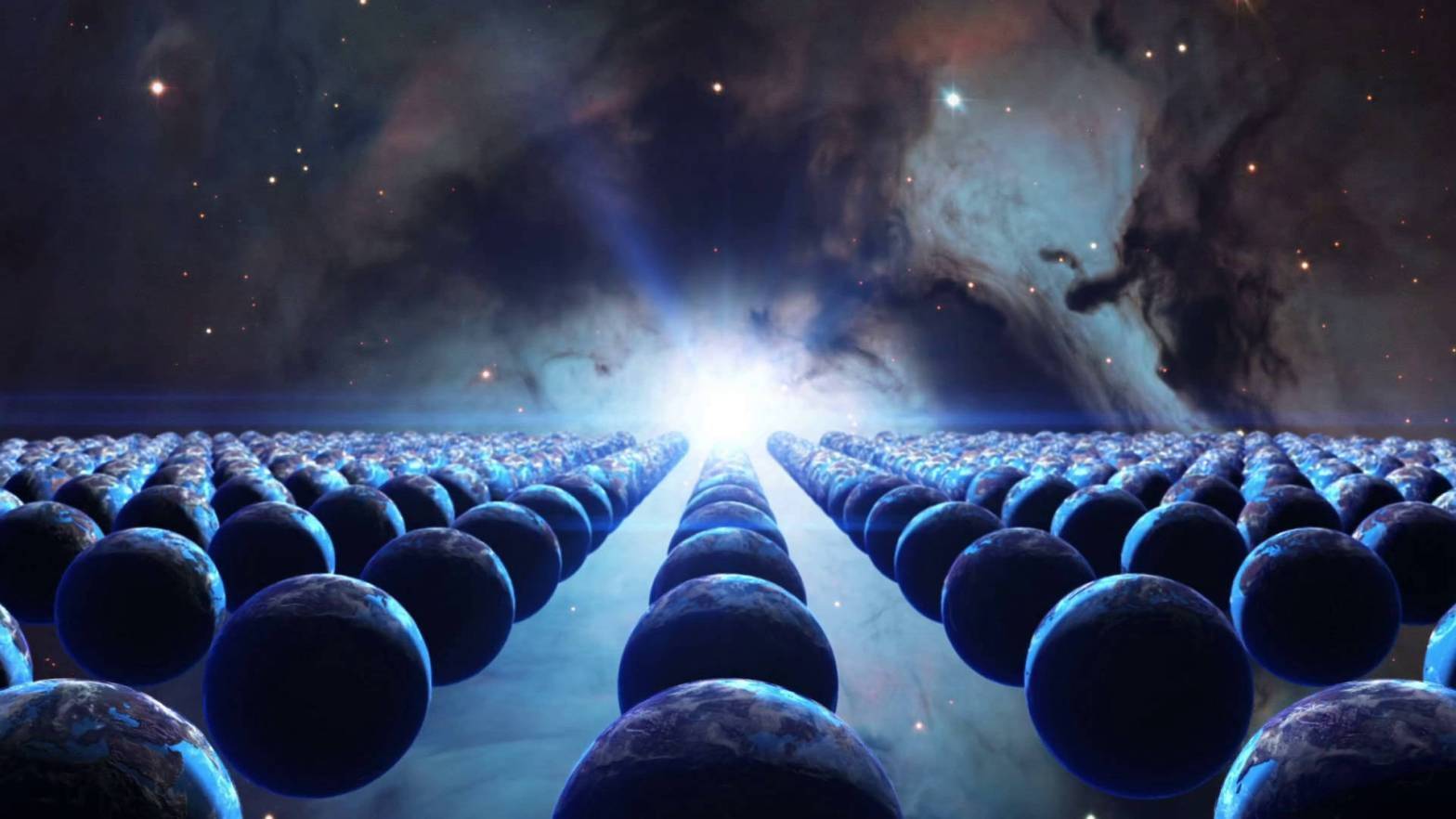
Around the turn of the century/millennium, people began to trend once more towards imagining many worlds. One aspect was the discoveries of quantum physics in the 19th century making their way into global popular consciousness in the form of the multiverse. The multiverse idea grew in popularity throughout the 2000s and 2010s. Multiverses now permeate our popular thought and popular culture. From Rick and Morty and Marvel movies to the Mandela Effect and internet conspiracy theories, across geographies and demographics humans have become aware of the idea of multiverses.
Previous paradigm shifts in thought have been incorporated into the One World. Knowledge of the New World, Outer Space, Evolution, and the Big Bang have all been wrestled with and added back into a single known universe. Despite tensions, all have proven to be fundamentally compatible with the Western Euro-Christian worldview of the One World. The Big Bang, for example, is in line with the sudden pinpoint creation of the one universe by the one God.
The multiverse, however, is fundamentally incompatible with the One World. A multiverse of discontinuous by definition cannot be rendered coherent and united. The multiverse cannot be connected, cannot be understood, cannot be controlled. We cannot know, and have no reason to imagine, that everything in these other universes is the same. To believe that across the infinite possibilities of multiverses, everything could be under any one sameness, one world, one truth, seems impossible. The multiverse is inherently polytheistic, inherently poly-everything. Just as one cannot imagine anything different when imagining the One World, one cannot imagine everything the same when they imagine the Many Worlds of the multiverse.
The collapsing of global life into sameness has never been more advanced in this universe. But imaginations are growing. Everywhere people are imagining many worlds. Worlds that have been, worlds that have never been, worlds that may yet be. People across the world are rediscovering the confidence to dream in their own worlds and worldviews. Traditional dress and assertive cultures are rising everywhere. People are pursuing different ways of life in a multitude of ways, like slow fashion, slow foods, no devices, lay flat, and other economically heretical movements. Politics are trending towards a new multi-polarity. Across the falsely divided categories of thought, the One World is being challenged.
On its own, these movements could be recuperated back into One World, one totalizing flattening sameness. Together, they are symptoms of a deeper earthquake under the foundations of the One World. An imagination which cannot be reincorporated. A practice of imaging that challenges the existence of One World. The recent revelation that the total world population has likely been vastly undercounted further shakes the world. Even the known world is not so known.
Talking to folks in this Federal Prison, opinions are polarizing. Belief in multiverses has been rising, and on the other side belief in a single Flat Earth has been rising.
Many Worlds implies, and is implied by, every difference and possibility that can be imagined: different lands, different people, different plants and animals, different cultures, different foods, different gods, different ideas, different technologies, different communities and rules, different lives. The trend towards believing and imagining many different worlds and away from believing in and imagining one world is the biggest fundamental shift in the thinking of humans today. We should consult with the whales about this.
Part 4: Conclusion
The multiverse is not typically what is meant in discussions of ‘many worlds’. Many Worlds generally refers to different ways of life or modes of being as a framework to analyze and criticize power and domination. This piece is not intended to be a good critique of power or attempt to describe Many Worlds. It is an attempt to identify a trend against One World operating on the level of thought and imagination. A trend that includes the multiverse as both a cause and a consequence of the trend. The fundamental contention is this: you cannot believe in one world and imagine many worlds, you cannot believe in many worlds and imagine one world. The One World is breaking down in the realm of our imagination.
Benjamin Song 11137512
FMC Fort Worth
PO Box 15330
Fort Worth, TX 76119

