
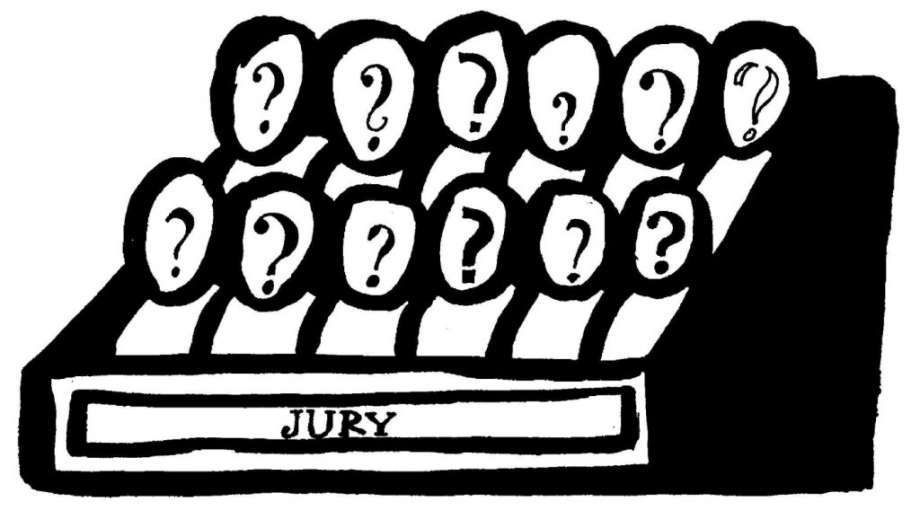
The U.S. Supreme Court has held that reasonable doubt is a fundamental requirement of due process.1 And it is reasonable to believe that there is a universal consensus here. But many courts, for a variety of reasons, declare that reasonable doubt should not be defined.2 One judge in fact said to the jury, “who are we to tell you what is reasonable and what is not? That is wholely within your purview.”3 In 1881, and again in 1887, the Supreme Court offered, that reasonable doubt “may be, and often is, rendered obscure by attempts at definition, which serve to create doubts instead of removing them,”4 but, at the same time, the High Court avers that it “has never held that the concept of reasonable doubt is undefinable, or that trial courts should not, as a matter of course, provide a definition.”5 According to the late Justice Ginsberg, “the words ‘beyond a reasonable doubt’ are not self-defining to jurors,”6 and she then goes on to state that “(s)everal studies of jury behavior have concluded that ‘jurors are often confused about the meaning of reasonable doubt’ when the term is left undefined.”7 And being in apparent agreement with Second Circuit Chief Judge Jon O. Newman, she invites us to consider his words: “’I find it rather unsettling that we are using a formulation that we believe will become less clear the more we explain it’”8 And for this part, Justice Blackmun offered the following: “To be a meaningful safeguard, the reasonable doubt standard must have a tangible meaning that is capable of being understood by those who are required to apply it. It must be stated accurately and with the precision owed to those whose liberty or life is at risk.”
So there we have it, straight fro, the lips of Justice Blackmun of the U.S. Supreme Court, the reasonable doubt standard of proof, because it does not have a tangible meaning, because it is not capable of being understood by those who are required to apply it, and because it has not been accurately stated, with precision, is not a meaningful safeguard against the State illegitimately depriving one of life or liberty.
Steven McCain 2096064
PO Box 660500
Dallas, TX 75266
1Miller v. Shealy, Jr. “A Reasonable Doubt About ‘Reasonable Doubt’”, 65 Okla L. Rev. 225, 227-228 (2023)
2Daniel Pi, Francesco Parisi, and Barbara Luppi, “Quantifying Reasonable Doubt”, 72 Rutgers U. L. Rev. 455, 455 (2020)
3Wansing v. Hargett, 341 F.3d 1207, 1214 (10th Cir. 2003)
4Victor v. Neb., 511 U.S. 1 (1994) (Ginsberg, J., concurring) (quoting Miles v. United States, 193 U.S. 304, 312, 26 L.Ed 481 (1881); Hopt v. Utah, 120 U.S. 430, 440-441, 30 L.Ed 707, 7 S.Ct. 614 (1887))
5511 U.S. 1 at 26
6Id.
7Id. (citing Henry A. Diamond, “Defining Reasonable Doubt”, 90 Colum. L. Rev. 1716, 1723 (1990). This article is mistitled in this cite. The actual title of the article is “Reasonable Doubt: To Define, or Not to Define.” (citing studies)
8Id. (citing Jon O. Newman, “Beyond ‘Reasonable Doubt’”, N.Y.U. L. Rev [979, 984 (1993)]. This cite contains a correction. In the Lexis database, Victor v. Neb., at 25, has a hyperlink whose text shows, “68 N.Y.U. L. Rev. 201, 204 (1994)”, but this link takes the user to an article by 19 Authors, “The Law of Prime Numbers”, 68 N.Y.U. L. Rev. 185 (1993). Justice Ginsberg, on page 26 of Victor, references back to Jon O. Newman, Beyond ‘Reasonable Doubt’”, placing it at ¢* N.Y.U. L. Rev. 205-206, but following this address leads the user to Robert L. Carter, “Thurgood Marshall”, 68 N.Y.U. L. Rev. 205 1993).
 Mongoose Distro